How We Took an Arkansas Airbnb From $30K to $60K in One Year

Let's start with the honest part: we didn't remodel the place.
We didn't add a hot tub, we didn't knock out a wall, and the owner didn't pour a pile of cash into upgrades. It was the same single-family home in the same Jonesboro neighborhood, with the same beds and the same square footage it had the year before.
In twelve months, it went from about $30,000 in annual revenue to roughly $60,000.
When it came to us, the house had everything going for it except the way it was being run. The photos were rough, the description was flat, and the pricing hadn't been touched in ages. Nothing about the listing was doing the place justice — and that turned out to be very good news, because every one of those things is fixable.
The reason that matters to you is simple: almost everything that doubled that number is something a lot of self-managed listings are getting wrong right now. So here's what actually moved the needle, and the takeaway you can carry into your own listing from each one.
1. The photos were costing bookings before anyone read a word
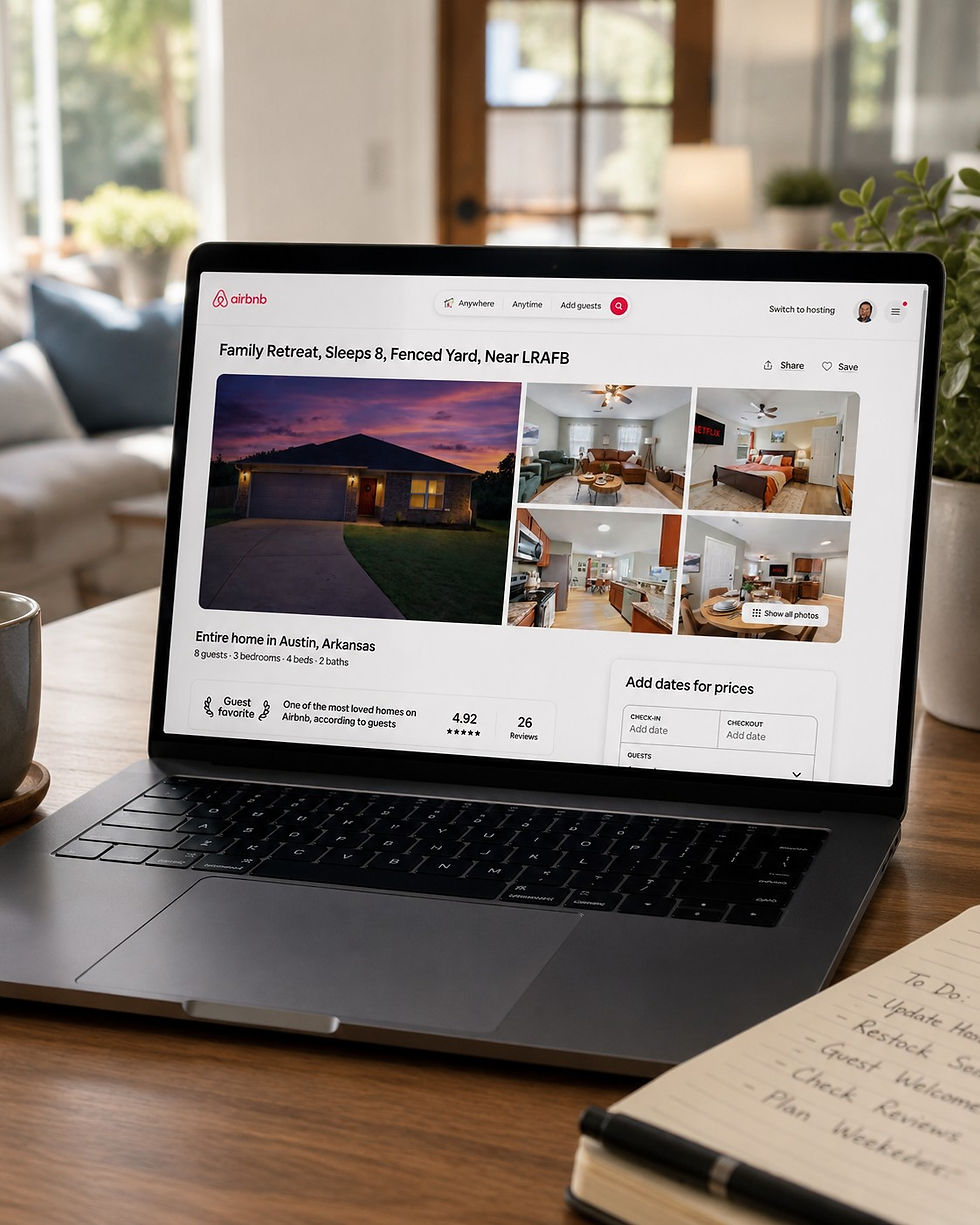
When we took it over, the listing had photos that were dark, crooked, and — we'll say it kindly — looked a little like dog water. Here's the thing owners underestimate: your photos aren't decoration. They're the entire first impression, and they decide whether a guest clicks at all.
On every booking platform, your cover photo drives your click-through rate, and your first five photos decide whether anyone scrolls far enough to read your description. A gorgeous listing with a bad cover shot performs like a bad listing. We reshot the whole thing with proper lighting and led with the strongest room instead of the exterior.
Your takeaway: Look at your cover photo right now. If it's the front of the house or a dim room, swap it for your best-looking, brightest interior shot — the one that makes someone think "I want to be in there." That single change often lifts clicks more than any price cut.
2. The nightly rate never moved — so it was wrong most of the year
The old pricing was set once and left alone. One flat rate, all year. That feels safe, but it quietly bleeds money in both directions: you sit empty in slow weeks because you're priced too high, and you sell out instantly in peak weeks because you're priced too low and left money on the table.
Demand in Jonesboro is not flat. A weekend when Arkansas State has a home football game, graduation, or move-in is worth far more than a random Tuesday in February, and your calendar should reflect that. We started pricing the calendar to breathe with demand — up for peak weekends and events, down to fill gaps in the slow stretches.
Your takeaway: Pick your ten highest-demand dates this year — big local events, holidays, peak-season weekends — and raise your rates on them today. Then find your slowest month and lower it enough to actually fill. You don't need fancy software to start; you need to stop using one price for 365 different days.
3. The listing title was invisible in search
The old title just said the property name. That's a wasted asset. On most platforms, the words in your listing title and description affect whether you even show up when a guest filters and searches.
We rewrote the title and copy to lead with what guests actually search for — the things that make this place worth booking, in plain, specific language.
Your takeaway: Rewrite your listing title to name your two strongest selling points, not just the house. "Quiet Cabin, 10 Min to the Lake, Hot Tub" beats "The Smith Place" every single time. Be specific; specific is what people search.
Those three — the photos, the pricing, and the listing copy — were the big fixes this particular house needed. But doubling a number isn't only about repairing what's broken. It's about running the operation well every single day after that. Here's what that part looked like.
4. Fast responses kept the listing climbing
Once the listing looked right and priced right, the next lever was speed. The booking platforms actively reward fast response times with better placement in their search results — slow replies quietly push you down the list, which means fewer eyes, which means fewer bookings, in a loop.
Handling every guest message quickly and consistently is a big part of what kept this listing climbing instead of stalling.
Your takeaway: Turn on notifications and aim to answer every inquiry within an hour, every time. If you can't, that's one of the clearest signs it's time for help — because response speed directly affects how often your listing gets seen.

5. Reviews weren't being earned on purpose
A stack of strong, recent reviews is one of the most powerful things a listing has — it drives both ranking and the guest's decision to book. The old listing was just hoping for good reviews. We started earning them on purpose: nailing the little things guests actually notice, and — when something did go wrong — getting ahead of it.
When a guest hits a snag at one of our properties, we don't go quiet and hope. We own it, fix it, and send a small apology their way — usually a charcuterie board, or a basket from our cleaner. A guest who felt taken care of during a problem often leaves a better review than one whose stay was merely fine.
Your takeaway: Build one genuine "wow" moment into every stay — a local treat on the counter, a handwritten note, spotless details in the first room they see. And when something goes wrong, respond fast and make it right before checkout. Recovered problems become five-star reviews far more often than you'd think.
6. We stopped leaving gap nights on the table
One quiet source of lost revenue on almost any calendar is the orphan night — a single empty Wednesday stranded between two bookings that nobody can fill because the minimum-night rule won't allow it. Those nights just evaporate, unbooked, all year long.
We set the minimum-stay rules so those gaps could actually be sold.
Your takeaway: Look for one- and two-night holes between your bookings. Lower the minimum-night requirement to fit them, and you'll capture revenue that's currently vanishing off your calendar every month.
What it all adds up to
Notice what's not on this list: no renovation, no new furniture, no gimmick. Just a series of fixable operational things, done consistently, on the same house.
That's the honest truth about this business — the gap between a $30K listing and a $60K listing usually isn't the property. It's the operation running behind it. Any one of these changes helps a little. All of them together, maintained every single week, is what doubles a number.
And that last part — every single week — is the catch. Doing this once is a good weekend project. Doing it relentlessly, all year, while you also have a life, is the part that wears owners down. That's the work we take off your plate.
If your listing could be doing more
If you read that list and recognized your own listing in two or three spots, that's genuinely good news — it means there's room, and the fixes are known.
Send me your listing and I'll take an honest look and tell you the one or two changes most likely to move your number the fastest — even if you decide to make them yourself. I'd rather you have a better-performing property than wonder what you're leaving on the table.
Call or text me directly at 720-491-9459, or reach us at southern-accommodations.com or Info@southern-accommodations.com. You'll always get a real person — never a bot or a hold queue.
The best part of this work isn't the revenue chart. It's the call where an owner tells us they finally feel like their property is living up to what they saw in it when they bought it. That's the whole point — helping your place become what you always believed it could be.


Comments